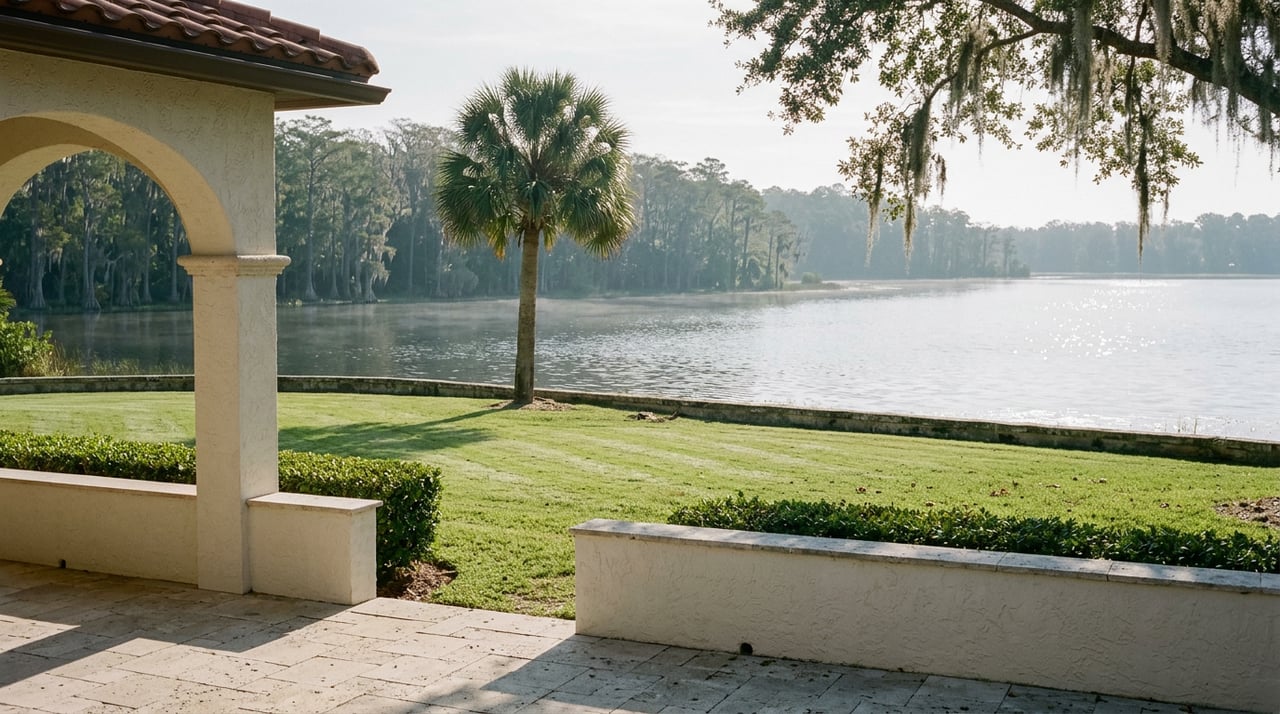
Ask two Dr. Phillips neighbors what the park costs and you will get two different, equally correct answers. One says it is free. The other says it is a dollar a head. Ask a third about the trail behind the ballfields and you will hear either "peaceful morning walk" or "found a bench sitting in the lake, turned around." Nobody here is wrong. They are describing the same 43 acres on Big Sand Lake at different hours, on different days, in different seasons, because Dr. Phillips Community Park does not run on one set of rules. It runs on at least four.
The park sits at 8249 Buenavista Woods Blvd, on the shore of Big Sand Lake, and on paper it looks like a standard community amenity list: a splash pad, a playground, ball fields, sand volleyball, a dog park, picnic pavilions, and a short nature trail. What that list does not show is that the park changes its own terms depending on when you show up, and residents who have lived here through a full calendar year learn to read those terms the way they read the weather.
The Splash Pad's Backwards Math
Most people assume a splash pad is cheapest and quietest on a random Tuesday. At Dr. Phillips Community Park, the opposite is closer to true. Admission runs a dollar per person per session, but that dollar only gets charged on weekends from March through October, and on weekdays during the peak of summer, June through August. Outside that window, on an ordinary fall or spring weekday, the splash pad is free. So the moment families most want to use it, when school is out and the heat is at its worst, is exactly the moment the county charges for it. The water itself runs on its own clock too: the sprayers and fountains cycle through a timed schedule with short breaks built in every hour, which is a small mercy on the days when the pavement is hot enough to explain why the fee schedule exists in the first place.
A Trail That Checks the Rain Before You Do
The park's nature trail is called the LongHorn Steakhouse Loop. It covers just six-tenths of a mile through roughly ten acres of upland habitat, sand pine scrub and xeric hammock, which is a more ecologically specific description than most neighborhood loop trails get. That habitat is also part of why the trail is inconsistent. Visitor reports describe two different trails depending on recent weather. On a dry week it reads as a quiet, shaded escape with birdlife along the lake edge. After heavy rain, entrances have been described as overgrown, and one visitor reported finding a bench sitting directly in standing lake water. The dog park, on the other side of the property, has its own drainage complaints after storms. None of this makes the trail unusable. It makes it the kind of amenity where a resident's local knowledge, knowing to check conditions after a wet week, does real work that a first-time visitor does not have.
The Dog Park Closes Before You Think It Does
The park's general hours run 8 a.m. to 8 p.m. daily, but the dog park inside it does not share that schedule. It closes at 6 p.m., two hours before the rest of the property, which catches people who assume one gate means one set of hours. Inside, the layout splits into sections for dogs over 30 pounds and under 30 pounds, with water fountains for both. It is a detail that only matters once, usually to whoever shows up at 7:15 with a leash in hand and finds the gate already locked.
Friday Nights Turn the Grass Into the Neighborhood's Living Room
On select Friday evenings throughout the year, Orange County Parks and Recreation runs a free Movie in the Park series here, with screenings starting around 6:30 to 7 p.m. depending on how late the sun is setting that week. There is no ticket and no reservation. Food trucks typically set up on site, or families bring their own blankets and snacks and claim a patch of grass facing the lake. The films skew toward family-friendly PG titles, past screenings have included Shrek 2, and the practical advice that circulates among regulars is to arrive at least half an hour early if you want a spot near the water rather than back by the parking lot. It is one Friday-night occasion when the park's various constituencies, splash pad families, ball field parents, and dog walkers end up on the same lawn at the same time.
Where the Whole Year Points
If the park's rhythm builds toward Friday nights, the annual rhythm builds toward November, and when it arrives, the gathering does not happen at the park at all. It moves half a mile down Sand Lake Road to Dellagio Town Center, the Tuscan-inspired retail and dining complex built in 2008 and 2009 by Unicorp National Developments, the same firm behind ICON Park on International Drive. That is where the Rotary Club of Dr. Phillips Foundation hosts A Taste of Dr. Phillips each November, an event now in its 18th year that pulls together more than 20 restaurants from the Restaurant Row corridor for an afternoon of tastings, craft beer, wine, and live music, with proceeds going to local charities. Dellagio itself changed hands in March 2025, when Miami-based Core Investment Management bought the roughly 109,000-square-foot center for $37.5 million with plans to actively re-lease and refresh it, so this year's Taste of Dr. Phillips will run inside a property under new, still-settling ownership.
The park and Dellagio are not the only pieces of this pattern. A few minutes away, the Dr. P. Phillips YMCA Family Center on Dr. Phillips Blvd underwent a capital overhaul of its aquatics facilities, including its signature slide, funded by a $2 million grant from Dr. Phillips Charities and completed in time for the 2024 summer season. That relationship goes back further than the grant. Dr. Phillips Charities has supported the YMCA of Central Florida since 1954 and helped fund the creation of the Dr. P. Phillips YMCA itself back in 1983. The park, the pool, and the Friday movie nights all trace back to the same decades-long pattern of local philanthropy reinvesting in the same few blocks, which is part of why the amenities here feel less like standalone attractions and more like pieces of one long-running project.
Reading the Park Like a Local
None of this changes what the park is on a map. It is still 43 acres, still on Big Sand Lake, still built around a splash pad, a trail, a dog run, and some ball fields. What changes is what those 43 acres actually offer you on a given Tuesday versus a given Friday in November, and that is the part a listing photo or a satellite view will never show. A resident who has been here a year knows the splash pad is free on October weekdays and priced in July, knows to check the trail after rain, knows the dog park locks up before the rest of the gate does, and knows that come November, the real party moves down the road to a Tuscan piazza with a fountain modeled on one in Paris. That is not a fact you look up once. It is a fact you accumulate by living here long enough to notice the pattern.
If you are weighing a move to this part of Southwest Orlando and want the same kind of block-by-block, season-by-season read on a specific street or community, that is the conversation Andrea Alonso has every day. Let's connect. Start your Florida search.