Wondering if Brickell is all hype or if it actually delivers as a place to live? If you are considering a move here, you probably want more than glossy tower photos and skyline views. You want to know how daily life really feels, what is convenient, and what trade-offs come with the address. Let’s take a practical look at what it’s really like living in Brickell.
Brickell feels like true urban living
Brickell is part of Miami’s larger downtown urban core, a 927-acre district that includes Brickell, the Central Business District, and Arts + Entertainment. According to the Miami Downtown Development Authority, this area combines parks, office space, retail, residential buildings, hotels, and government functions in one dense environment.
That matters because Brickell does not function like a quiet, separated residential neighborhood. It works more like a compact, vertical district where homes, restaurants, offices, transit, and public space all sit close together. In real life, that often means your day is shaped by short walks, elevator rides, and shared spaces instead of long drives.
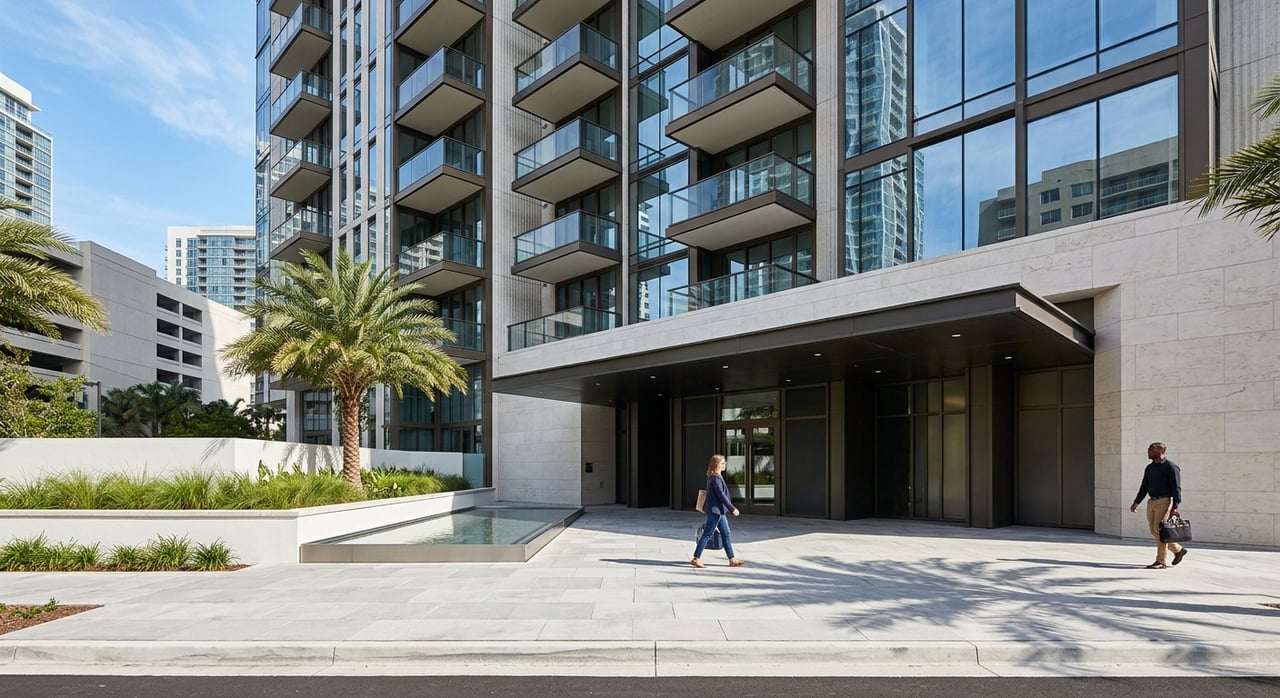
Daily life is built around towers
For many residents, living in Brickell means condo living in a high-rise setting. Brickell City Centre is one of the clearest examples of this pattern, with nearly five million square feet of mixed-use space that includes shops, dining, entertainment, and residential towers.
This setup creates a lifestyle that feels efficient and connected. You may live above retail, near office buildings, or a few blocks from transit. The upside is convenience, while the trade-off is that private yard space is usually limited and building life comes with shared amenities, elevators, and association rules.
Walkability is one of Brickell’s biggest perks
If you want a neighborhood where you can do a lot without getting in the car, Brickell stands out. Walk Score rates Brickell at 94 for walkability, 82 for transit, and 83 for biking, and notes that daily errands do not require a car.
That score lines up with how many people use the neighborhood. Coffee runs, grocery stops, dinner plans, and quick errands can often happen within a short walk. For buyers coming from more car-dependent areas, this is one of Brickell’s biggest lifestyle shifts.
Transit makes car-light living realistic
Brickell is not just walkable on paper. It also has real transit options that support day-to-day living.
Miami-Dade County says the Metromover is a free elevated people mover that serves Downtown Miami, Omni, and Brickell across 21 stations and three loops, including the Brickell Loop. It runs seven days a week from 5:30 a.m. to 10 p.m., with frequent service during rush hour.
For longer trips, Metrorail adds broader access across Miami-Dade County. The county says the system runs 25 miles, serves Miami International Airport, and operates daily from 5 a.m. to midnight.
The City of Miami trolley also helps fill in local trips. The Brickell route runs Monday through Saturday from 6:30 a.m. to 11 p.m. and Sundays from 8 a.m. to 8 p.m., with stops that include Brickell Key, Brickell City Centre, Brickell Metrorail Station, Kennedy Park, Mercy Hospital, and City Hall.
Errands, dining, and shopping are close
One of Brickell’s strongest lifestyle advantages is how much is built into the neighborhood. Brickell City Centre alone includes more than 100 shops, four levels of shopping, dining, and entertainment, plus a Saks Fifth Avenue anchor.
Its restaurant lineup also helps explain why so many residents treat Brickell as a self-contained district. The mix includes coffee spots, brunch options, casual bites, cocktails, sweets, vegan food, sushi, and steaks. That makes it easier to keep daily life local, especially if you value convenience and variety.
Outdoor space is urban, not beachy
Some buyers assume Miami living always means wide beaches and large green parks nearby. Brickell offers outdoor access, but the experience is more urban and structured than resort-like.
The Miami DDA says the Downtown Baywalk is 89% complete and the Miami Riverwalk and on-road Greenway is 68% complete. A 200-foot Baywalk section opened in 2023 at First Miami Presbyterian Church, helping connect Icon Brickell to 701 Brickell Avenue.
That tells you something important about the neighborhood. Waterfront access is real, but it is still evolving and feels more like a connected system of paths and linear spaces than one continuous promenade.
The Underline adds active outdoor space
The Underline gives Brickell another layer of outdoor living. City of Miami materials describe Brickell Backyard, the first phase of The Underline, as a half-mile segment from the Miami River to SW 13th Street.
This segment includes walking and biking paths, the Brickell Metrorail and Metromover stations, an outdoor gym, a flexible basketball and soccer court, gardens, and gathering spaces. For residents, that means outdoor time in Brickell often looks like walking, biking, commuting, or meeting up in active public spaces instead of spending the afternoon in a large traditional park.
Green space exists, but it is limited
Brickell is not all glass towers and pavement. There are green spaces nearby, though they are more limited and highly urban in character.
Alice C. Wainwright Park on Brickell Avenue includes waterfront access, a playground, outdoor gym equipment, and a natural forest community. Simpson Rockland Hammock Preserve Park is a 7.8-acre tropical hardwood hammock preserve and one of the last remnants of the historic Brickell Hammock.
These spaces add balance to the neighborhood experience. Still, if your ideal lifestyle depends on large lawns, quiet trails, or expansive open parkland right outside your door, Brickell may feel more compact than expected.
Brickell is polished, but busy
One of the most honest ways to describe Brickell is that it is convenient, attractive, and active. It is also still evolving.
City and DDA project updates show ongoing infrastructure work and continued waterfront connections. The City of Miami’s Mary Brickell Village roadway and drainage improvements involved temporary traffic changes and long construction phases, while Baywalk and Riverwalk projects continue to develop over time.
For you as a buyer, that means Brickell can feel dynamic rather than settled. There is energy here, but not always quiet. If you love momentum and a downtown pace, that may feel exciting. If you want a slower residential rhythm, it is worth weighing carefully.
Who tends to enjoy living in Brickell?
Brickell often works best for buyers who want a car-light lifestyle, easy access to dining and shopping, and the convenience of condo living. It can also appeal to second-home buyers, luxury condo buyers, and international purchasers who want a central Miami location with strong transit access.
It may be especially attractive if you value:
- Walkability for daily errands
- Easy access to transit
- High-rise condo amenities
- A dense, modern city environment
- Nearby dining, retail, and entertainment
- Urban waterfront paths and public spaces
On the other hand, Brickell may feel like a mismatch if you strongly prefer:
- Detached homes with private yards
- Quiet streets and low-rise surroundings
- Large neighborhood parks
- A more residential, slower-paced atmosphere
What living in Brickell really comes down to
At its core, Brickell offers a very specific kind of Miami lifestyle. It is vertical, walkable, amenity-rich, and connected. You are choosing convenience, density, and access over space and separation.
For the right buyer, that trade is absolutely worth it. If you like the idea of stepping out of your building and having transit, dining, shopping, and waterfront routes within reach, Brickell can be a strong fit. If you want more privacy, more land, or a quieter everyday setting, you may want to compare it with other Miami-area options before deciding.
If you are exploring Brickell as a primary home, second home, or luxury condo purchase, working with a team that understands both the lifestyle and the practical details can make the process much easier. To start your Florida search with concierge-level guidance, connect with Andrea Alonso.
FAQs
What is daily life like in Brickell for residents?
- Daily life in Brickell is shaped by high-rise living, walkability, nearby dining and shopping, and easy access to transit and shared public spaces.
Is Brickell a walkable neighborhood in Miami?
- Yes. Walk Score rates Brickell at 94 for walkability and says daily errands do not require a car.
What public transit options are available in Brickell?
- Brickell is served by the free Metromover, the Metrorail system, and the City of Miami Brickell trolley route.
Does Brickell have parks or outdoor space?
- Yes, but the outdoor experience is urban in character, with baywalks, riverfront connections, The Underline, and nearby parks like Alice C. Wainwright Park and Simpson Rockland Hammock Preserve Park.
Is Brickell mostly condos or single-family homes?
- Brickell is primarily known for condo living in high-rise buildings within a dense mixed-use district.
Is Brickell a quiet place to live in Miami?
- Brickell is better described as active and busy than quiet, with ongoing development, traffic activity, and a fast-paced downtown environment.